
From sensory awareness to shared practice: scoping the PEAR TREE Lens into digital learning
At ASI Wise and Sensory Project, we have listened carefully to what NHS teams, community services, and multidisciplinary staff have told us. Again and again, the same message has come through: sensory support cannot sit with one champion, facilitator, or inclusion worker. If services are to become genuinely sensory aware, the understanding must be shared across the whole workforce.
In response, we developed accessible, self-directed online learning for all staff, from reception teams and healthcare assistants to psychiatrists, paediatricians, occupational therapists, physiotherapists, nurses, doctors, and wider colleagues. This universal foundation helps teams think more carefully about how sensory systems shape communication, participation, distress, safety, and care in everyday practice.
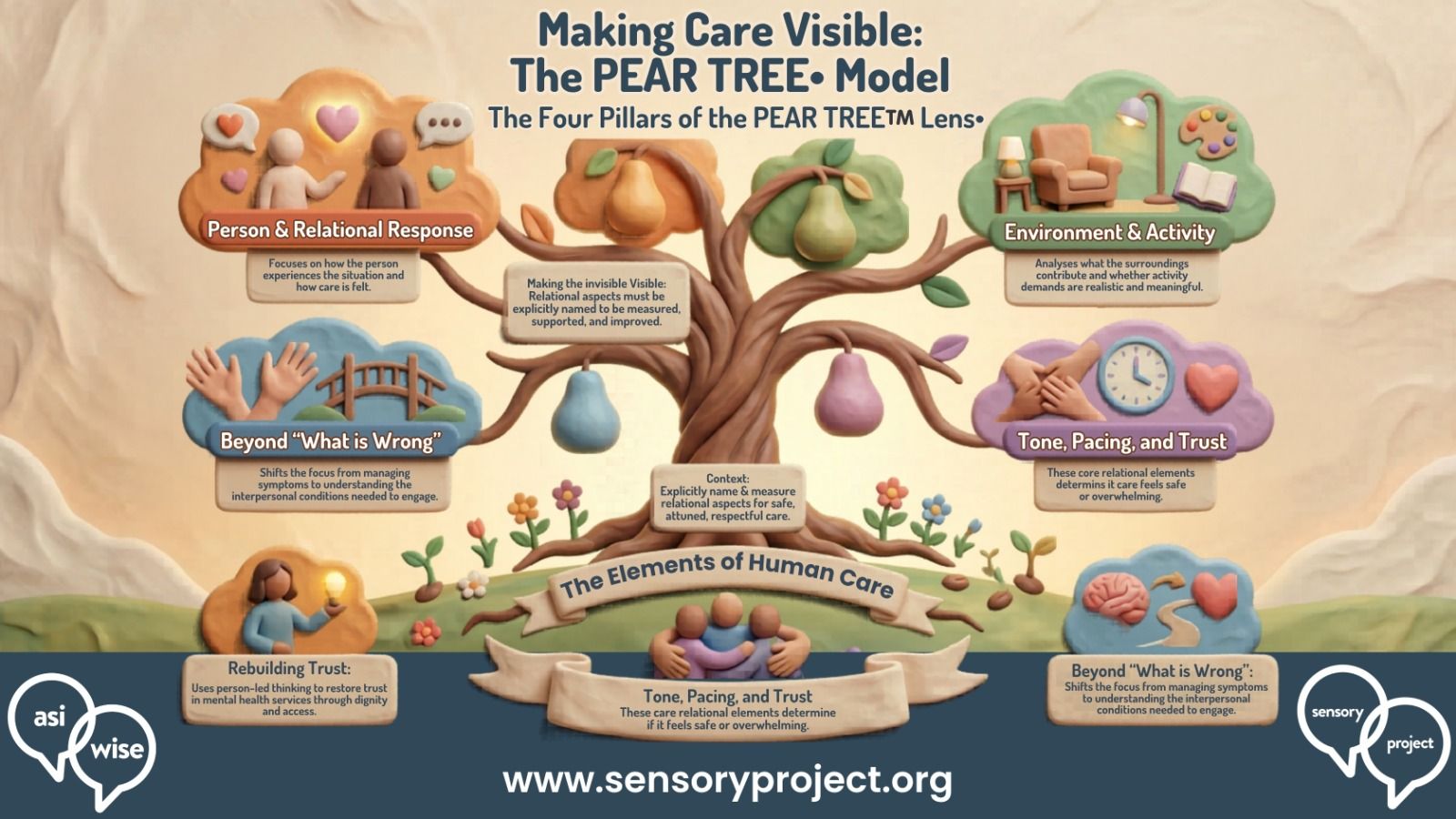
This work reflects a wider evolution in our clinical thinking. Drawing on practice, participation, research evidence, and lived experience, we have moved beyond traditional person-environment-task and person-environment-occupation models towards the PEAR TREE Lens. We use the word Lens intentionally, because people with lived experience told us they wanted something practical, flexible, and easier to apply in real life.
The PEAR TREE Lens offers a neuro-affirming framework that supports curiosity, context, collaboration, and co-produced meaning. It encourages professionals to shift from asking, “What is wrong?” to asking, “What might be happening here?” and “How is care being felt?” In doing so, it helps teams make better sense of behaviour, reduce misunderstanding, and embed more responsive support.
Across workshops, webinars, modules, and practical tools available through ASI Wise and Sensory Project, we are seeing how shared sensory language can strengthen clinical reasoning, improve consistency across teams, and help specialist occupational therapy expertise be better understood and more effectively embedded within wider systems.
Importantly, this learning does not replace specialist assessment or intervention. It strengthens the conditions that allow specialist practice to be used safely, effectively, and consistently.
Our next step is to scope how the PEAR TREE Lens can be translated into a digital app and toolkit, widening access to practical, sensory-aware learning and support. Because sensory awareness is not the responsibility of one role. It is everyone’s business.