
Hygiene without hazards: latest clinical approaches and solutions for safer bathroom routines
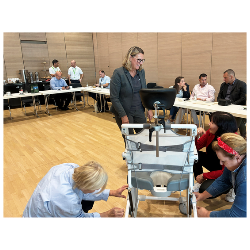
Safe toileting and personal hygiene are fundamental to dignity, independence and health. Yet bathroom routines frequently combine demanding movements with wet surfaces, restricted space and hard fixtures. As healthcare professionals, we understand reducing these risks requires careful analysis of our clients, their environments and individual occupations (PEO model1). However, disabilities are becoming increasingly challenging and diverse alongside more complex living spaces - so how do we maintain best bathroom moving and handling best practice now and in the future?
Currently, UK public health guidance2 estimates that one-third of people aged 65 and over, and half of those aged 80 and over, fall annually. In England alone, falls among people aged 65 and over accounted for 221,600 A&E admissions in 2024/25, including 143,874 among those aged 80 and over3. These statistics cover falls across all settings, demonstrating the scale of the prevention challenge not just the risks in the bathroom.
In response to this, the Royal College of Occupational Therapists (RCOT) launched its landmark follow-up report project, 'Building Health into Homes', in June 20264. Building directly upon the foundations laid by its 2019 'Adaptations without Delay' guidance, this project consists of a trio of resources designed to unlock the connection between housing conditions and public health. With 87% of homes in England failing to meet basic accessibility criteria5, the need for strengthened hygiene and reduced hazards particularly in community bathrooms is clear to see.
In terms of public and private sector care settings, this focus is equally as essential. Between 2022 and 2025, the Health & Safety Executive (HSE) estimated every year that 52,000 health and social care employees in the UK experienced work-related musculoskeletal injuries. The need for better posture, clearer training and improved equipment ergonomics is once again obvious.
Hence, these clinical priorities have led to Etac, a respected Scandinavian manufacturer of assistive equipment, organising topical educational sessions at the OT Show (NEC, 25-26th November) that focus on practical and proven solutions to bathrooms risks. These on-stand CPD sessions entitled “Hygiene without hazards: Clinical approaches and solutions for safer bathroom routines” will be presented by Tove Filipsson, BSc and MSc (one year), Physiotherapist and Etac Clinical Education Manager. Tove will explore accident prevalence, risks and practical approaches to safer care. She has been a qualified physiotherapist since 1996 and has over 18 years of clinical experience in geriatric rehabilitation, primary care and psychosomatic physiotherapy.
Tove comments: "Client assessment should encompass the complete hygiene routine, including access inside and around the bathroom. Therapists should observe transfers, clothing management, reaching and standing tolerance, while considering how lighting, thresholds, clutter and equipment positioning affect performance. Night-time routines deserve particular attention, when reduced visibility may compound existing mobility difficulties. We will explore these factors and the need for clinical holism at the OT Show. I look forward to exploring this approach more with professional peers on stand G40."
In terms of effective bathroom design, practical solutions range from appropriately positioned grab rails and shower stools to mobile shower commodes. Seated washing can reduce standing demands, while multifunctional equipment may reduce repeated transfers. Selection must consider postural support, hygiene access, transfer method, available space and the person’s preferences. Instruction and review are essential to establish safe, effective use. NICE identifies urinary continence and lying and standing blood pressure within comprehensive falls assessment where appropriate. Urgency or dizziness should prompt consideration of wider clinical factors.
Caregiver ergonomics are equally important. As an international example, Tove helped equip a residential bathroom within a collaborative project involving KTH Royal Institute of Technology in Stockholm. Comparing bathroom layouts and equipment, the project examined caregiver postures, movement and perceptions of safety. This approach reinforces the need to assess working space and assistance requirements alongside user function.
Therefore, in summary, a holistic approach is always best in terms of adaptations and equipment, not only in the bathroom, but around the home or any care environment. Seamless integration is key so safety, dignity and wellbeing can be preserved. For occupational therapists, this means connecting more with evidence-based material, deeper environmental assessment and more detailed consideration of equipment.
With strengthened clinical reasoning that facilitates participation, independence and sustainable care, the cost and time savings to the NHS and social care are immense. With the UK Government currently planning a new 'National Care Service' there is no time more relevant than now to implement better practice and assistive equipment in assisted bathrooms.
Note: All professional attendees to the Etac on-stand educational sessions will receive a free CPD certificate.
References
1. The Person-Environment-Occupation (PEO) Model is an occupational therapy model of practice, which was developed in Canada by Mary Law, Barbara Cooper, Susan Strong, Debra Stewart, Patricia Rigby and Lori Letts in 1996.
2. Office for Health Improvement and Disparities (2022). Falls: applying All Our Health. GOV.UK.
3. Department of Health and Social Care. Fingertips: Emergency hospital admissions due to falls in people aged 65 and over and people aged 80 plus, England, 2024/25.
4 and 5. Royal College of Occupational Therapists (2026). Building Health into Homes: Strategic Report. London: RCOT.